Journey Of Online Media

Journey of Online Media is the platform to know more about online media, online ad operations, email marketing, social media marketing, search engine marketing and more about Ad server and all…

Journey Of Online Media

Journey of Online Media is the platform to know more about online media, online ad operations, email marketing, social media marketing, search engine marketing and more about Ad server and all…

Journey Of Online Media

Journey of Online Media is the platform to know more about online media, online ad operations, email marketing, social media marketing, search engine marketing and more about Ad server and all…

Journey Of Online Media

Journey of Online Media is the platform to know more about online media, online ad operations, email marketing, social media marketing, search engine marketing and more about Ad server and all…

Journey Of Online Media

Journey of Online Media is the platform to know more about online media, online ad operations, email marketing, social media marketing, search engine marketing and more about Ad server and all…

Showing posts with label Marketing. Show all posts

Tuesday, 5 November 2013

How Digital Marketing Is Affecting the Growth of Small Business (SMB)

Digital marketing is an essential and cost effective strategy to promote small/medium business.  An online marketing strategy is an important part of the overall marketing strategy of a business. This is true whether or not a company is doing business online. It is also true for a small, medium or large size company but especially true for a small company.

Small business marketing for a local company can include many offline local advertising methods but needs to include a healthy portion of internet marketing strategies to be successful and maximize sales in today's economy. A small business that is doing most or all of its business online, needs to embrace an internet marketing strategy that helps it be seen by online users.

Five Key Areas of Online Marketing for Small Business  

There are five areas of online marketing to improve the growth of small business. Some of them are more important to local, offline businesses, while others are more effective with online businesses. Many businesses engage in all five areas of small business marketing on the Internet.
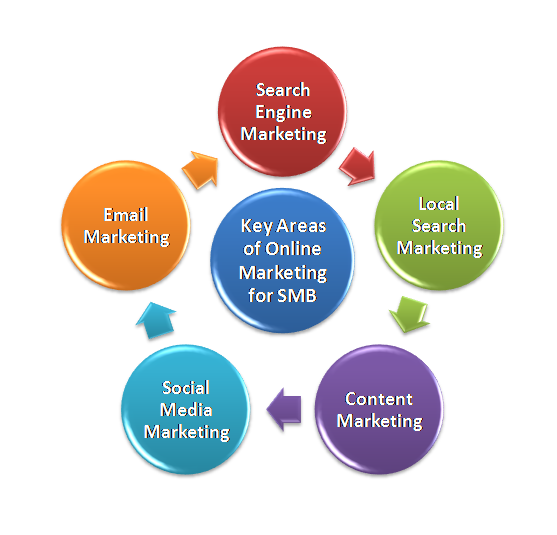
Search Engine Marketing
This portion of digital marketing is critical for a small business. It provides a chance to compete with larger companies by being visible in search engines. Since people use search engines to find products both online and locally, it is important that your company place top in search results for words that relate to what you are selling. Professional Internet marketing firms offer this service under the name of search engine optimization. They can make sure your site is visible to those looking for your product when using a search engine.

Local Search Marketing
This includes website optimization for search results, but in addition, integrates a search engine's function of maps. This is especially true with Google, where your business can be listed with mapping and address information, giving a prospective customer what they need to visit your establishment. Your phone number and website address can also be listed. Customer services will often be available to help someone decide if they are interested in your product or service.

Content Marketing
This strategy revolves around providing a prospective customer information about your product or service, as well as information in general. People will attribute a certain level of expertise to a company, and this instills confidence in the consumer. Content marketing in the past was often done with printed brochures and guide books, but today, this can be done with articles and other forms of information on a business's website.

Social Media Marketing

This type of marketing can be tricky. Everyone talks about social media, but the truth is, it can be difficult for companies to integrate social media with their business. The type of media used, as well how it is used, is dependent upon the type of business you have. For some companies being in touch with their customers and giving them breaking news can be an important element of success. Other business such as a local restaurant, have seen success using social media by letting customers know of the latest specials and new additions to their menu. The most important aspect of social media is to use it to strengthen your customer base to achieve repeat sales.

Email Marketing
This form marketing is crucial to a small business online or offline. Essentially email marketing is about building a list of customers and prospective customers. This list of names and emails are people who are interested in your business, and you know this to be true because they have opted into this list themselves. Perhaps they were offered future updates on products as well as coupons to sign up. As this list grows, it becomes more valuable. In fact, many marketing professionals consider this to be, in the long run, the most important small business marketing strategy in the long run.

Steps To Promote Your SMB through Effective Digital Marketing Channel

Importance of Google – with approximately 80% of all searches being conducted via Google, it is critical to primarily focus SEO effort on this search engine. Yahoo and Bing are less important but still an important part of search engine marketing.

Keyword Selection – Pick keywords that are relevant to your business but also fairly easy to rank for. Look for multi-word phrases or ‘long-tail keywords’ as they are usually less competitive

Content is King - Prospects are more likely to buy from you if you are a thought leader, so establish yourself as one by creating extraordinarily helpful content. Take decisive action to ensure prospective customers are attracted to your site as a place to find answers.

Generosity is Also King – Another key part to attracting customers is your generosity in giving away information, access to tools, etc.,

Social Media – Focus on the top three social media venues: Twitter, Facebook, and LinkedIn. Remember, ‘be real’ and ‘be there’ to help the community rather than to push products.

Calls-to-Action – It is an important to provide something of value that solves a problem for visitors in exchange for their contact information. Often traffic will not be ready to buy right away, but a tempting call to action will lead them down the sales funnel.

Landing Pages - Everything that has been done to draw qualified traffic to a site, from improving SEO, to generating great content comes to a head in the landing page. Leads should be confronted with an inescapable case for them to leave their carefully guarded personal information on the form. Having one offer, recapping benefits, and a short form are all key.

Lead Nurturing – follow up calls to action with a ‘thank you’ email and a lead nurturing campaign that further entices leads down the sales funnel with additional free offerings– this is a free opportunity to keep touch with a lead.

Tracking Progress – Effective Inbound Marketing is all about experimentation. Select a strategy based on experience with customers and industry to get people to both visit and convert on the website. But anticipate that initial assumptions about keywords, or what it takes to get traffic to convert will not be right (or not right enough) and changes will need to be made. For this reason, it is essential to have a complete internet analysis tool-suite to help figure out what’s working and what’s not.

Patience & Tenacity – It’s easy to become discouraged and frustrated if Inbound Marketing is approached as a point solution. In reality, it’s a long term strategy only rewarding those who approach it with patience and tenacity.

Click here to download the high resolution info graphic
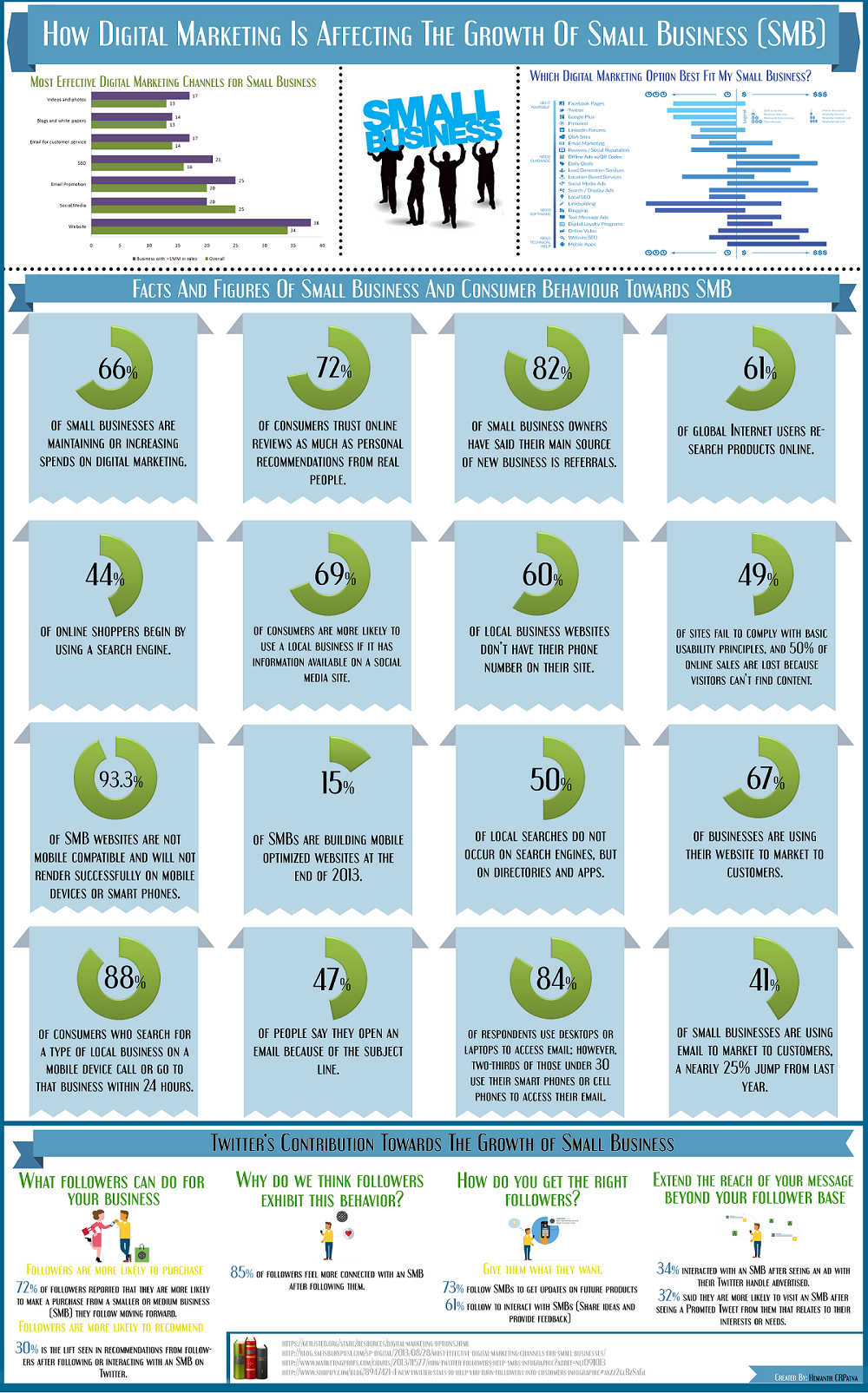
 

Click here to download the high resolution infographic

Conclusion:
Online marketing is the effective channel to promote small business in wide range of geographical area with minimal cost.  Also it will purely depend upon area of business and the industry which you are promoting to your targeted audience.

Above described areas and steps to improve small business through internet marketing are helpful to promote the business in desired geography. Formulating the plan and combining it with other marketing efforts are also very much important to grow in tremendous way.
Online marketing strategies that are often outsourced include social media, search engine and local search marketing, because unless you have time to dedicate it's difficult to stay on the multiple changes that transpire when it comes to strategy. With content and email marketing, you can do much of it yourself, but it never hurts to ask experts for strategy advice to help get you started.
Source: http://www.siliconindia.com/blogs/blogs_new.php?30Sfk6297ltsXB39TX3KE01fg68xhnCy

Why Publisher Need Own Ad Server


As an advertiser, there is no better way to purchase massive amounts of online display ad inventory than directly from publishers or ad networks. Granted, there is more legwork involved when compared to programmatic buying, and the CPM rates can be quite high — but this is offset by the ability to reserve large amounts of inventory.

When you’re buying media in bulk, the need for a proper ad server is very important in terms of controlling your ad operations. You could say that it’s a best practice to use your own ad server, especially if you run a consistent volume of ad campaigns.

How Ad Servers Work Together

To illustrate why you need your own ad server, it is important to first understand how ad servers work. In the below example, the advertiser’s ad server is managing its campaigns across four different publishers. This is accomplished by providing each publisher with their own unique “ad tag” script (generated by the advertiser’s ad server), which the publisher then inserts into its ad server associated with the corresponding website.


You might be asking yourself: “If the publisher has an ad server, why would I need my own?” Here are seven reasons.

1. Accountability
Tracking your own campaign statistics is probably the most important reason you should have your own ad server. When you’ve been around the online advertising space long enough, you come to realize that some degree of discrepancy is inevitable. Mid single-digits percentages are pretty normal, though it can vary wildly in different cases. With so many different ad tags being served by so many different ad servers in various locations around the world, it really shouldn’t be surprising that reporting will differ to some degree.

Without your own ad server, you have no independent stats against which to audit the results being reported by the publisher. The old adage “trust, but verify” holds true when it comes to buying online media. Having your own ad server allows you to keep publishers and ad networks accountable.

2. Creative Control
Giving a publisher or ad network your ad tags to run in their ad server gives you control over what ads are served to which users, and how. From a creative perspective (depending on the ad server you use), you can have more control over the format of your ads, such as running text ads, video ads or expandable ads.

Beyond control of the ad formats being run, using your own ad server affords you the ability to optimize delivery of your ads as well. Your ad server can give you the ability to split-test different ads and weight which will be shown accordingly.

3. Insights
Not using your own ad server means that you are at the mercy of the publisher’s when it comes to mining campaign insights. The fact that reporting transparency differs from publisher to publisher means that you will likely be left with an incomplete picture.

Using your own ad server provides you with the greatest possible transparency into the performance of your campaigns, giving you insights that otherwise would not be visible. Using your own ad server, you can look at placement stats, geographic stats, creative stats, and hourly stats, all on multiple levels, to determine what is and what isn’t working.

4. Centralized Management
Without your own ad server powering your direct buys, you will oftentimes have to rely on the publisher’s ad operations team to create and manage your campaigns. Multiply this by the number of publishers you work with, and you can imagine how the logistical complexity increases dramatically.

With your own ad server, you centralize management of your campaigns across all the publishers that you work with. You also aggregate all of your campaign statistics in a single database. The benefit of this approach is invaluable, which leads to the next reason to have your own ad server.

5. Data Ownership
One of the strongest arguments for using your own ad server, in my opinion, is that you own and control all of your campaign data. If you don’t have your own ad server and simply rely on publishers, you forfeit ownership and control over your own reporting. Trust me on this one: you don’t want to be beholden to a publisher or ad network for your historical campaign data.

6. Data Freshness
Publisher reporting practices vary. Some will report campaign results daily, weekly, even monthly. Oftentimes, this will come in the form of an email attachment. For some advertisers, this delay is acceptable; for performance-driven marketers optimizing toward an effective goal, such delays can mean costly, wasted ad spend.

In most cases, 3rd-party ad server reporting is close to real time. Having your own ad server allows you to see exactly how your campaigns are performing – up to the minute. This real-time reporting is essential to making timely and actionable decisions.

7. Data Privacy
If the goal of your campaigns is return on ad spend (ROAS), you will obviously want to be tracking revenue. However, you probably don’t want publishers knowing how much you profit on their ad inventory (for obvious reasons). Your own ad server gives you a discrete platform to confidentially track your campaign performance metrics.

The Caveat: Cost
Having the luxury of your own ad server typically isn’t free. There are some ad servers that offer free ad serving up to a certain number of impressions, but any serious media buyer will blow those limits away fairly quickly. The general cost of ad serving is anywhere from $0.01 to $0.10 CPM. You will also need to factor in content delivery network (CDN) costs, which are passed along to advertisers and range from $0.02 to $0.06 per gigabyte of transfer.

Checks & Balances
By not using your own ad server, you are pretty much flying blind and giving publishers all the power in the relationship. From a business perspective, it’s simply not prudent. This fact becomes especially important if you are doing any degree of high-volume media buying across multiple publishers.

Using your own ad server adds checks and balances to the process of media buying. It also adds a level of consistency for the media buyer, allowing all campaigns to be managed from a single point of control. While the publisher ultimately controls the flow of traffic, you can keep things on an even keel by leveraging a platform of your own to control and monitor the ad campaigns that get served — and ensure you are getting what you paid for.

Source: marketingland.com

Thursday, 11 April 2013

Online Marketing - The Smart Way of Promoting

Online marketing is one of the rising types of marketing segment to promote products and services in stunning way.  There are many smart ways online media is catching up the audience using different kind of technology to promote the commodities also it has enormous accessibility and reach it is easy to reach millions of users at one go.

Being the modern and hottest field online media advertising has become focus of attention in all the trading and service firms. According to the media experts online marketing mode carries a lot of prospected audience to make business. Also experts think that online media advertising is in game change period and soon it will beat other traditional media of advertising with its reach and sustainability.

The Smart ways of promoting

The sharpen technology discovering many more new systems to make strengthen of online marketing segment. Below are recent trends which are talk of the town in this industry.

  1. Real Time Bidding
  2. Behavioral Targeting
  3. Make the audience busy through Interactive Creatives
  4. Mobile App marketing
  5. Games on social media channel

Real Time Bidding: This is one of the booming technologies which enable high return of investment to the advertiser. Real time bidding will be a significant factor that can fulfill the promise of online marketing.
As defined by Parks Associates, the automated process of buying and selling online display advertising in real time, and it incorporates enhanced solutions in targeting algorithms and data analytics in order to deliver better targeting, greater control and more granular campaigns.

In general words we can easily compare real time bidding with stocks market and its operations, but whatever transactions happed in RTB is approximately o.6 seconds.  Once advertisement wins the bid for desired inventory it will start serving to the right audience at the right time. Even still lot more improvements are going on to develop this system and track the accurate data at real time. As predicted in 2012, by this yearend real time bidding is most game changing segment in online marketing.
Using Real Time Bidding, Facebook advertising exchange is assuring the conversions within 2 days to its advertisers and it is working in that advertising exchange with abundance of audience, targeting based on geographical, demographical and behavioral factors.

Behavioral Targeting: This is one of the major parameter that online media used to target the right advertisement to the right customer to get business done within estimated time.  These technologies assess user behavior through user’s activity on World Wide Web.  This technology tracking through user’s IP address and personal information which user has submitted while transacting something else on the web.  Through this user data, various types of the advertisement will target to the respective customers based on their behavior and demographical factors.
Through behavior targeting most of the online media networks retargeting the interested customers through a variety of offers and discounts. Also many data management companies will analyze this data and segmenting the data as per the behavior of a particular customer.
Make the audience busy through Interactive Creatives:  As technology develops, online media is also implementing new techniques to attract the customers towards its products or services. Now most of the displayed creatives which have eye catchy look, color, articles on ads, videos, offers, discounts and many more to attract the customer’s attention from its first impression.
These interactive creatives have all the features in single creatives and this leads customer busy with one of their pages or its services. Also through this kind of the creative we can track user’s activity in each and every second and over again using this data, advertiser can target those audiences for their new products or services.
Mobile App Marketing: Now a day’s most of all are using smart phones and through mobiles we are engaged on many social networks, e commerce services, personal email conversations and chats applications.  These applications will capture potential data of the respective customer and track their activities on web.  Through these kinds of the interactive applications, marketers will target their desired audience to promote the services to its desired pool of customers.

Advertisers are following their own strategies to stay at the top of the game using these mobile apps.  Few are listed as these are recent trends in 2013.

  • Retargeting and Real time bidding using mobile apps - Every successful mobile marketing campaign starts with successfully targeting those who will prove most beneficial towards the product or services.  The recent introduction of Apple's Advertising Identifier is helping to develop more complicated real-time bidding and retargeting technology, including the ability to exclusively target the inactive users in an effort to reengage through mobile apps and making other marketers jealous in the process.

Real-time bidding is truly a win-win for the mobile advertising industry, giving buyers more access and transparency while concurrently giving sellers a market-driven fair price.
Frequency of tracking -   This is one of the high debated topics across the industry and still it is going on in this year with lot of facts and figures. Using Unique Device Identifier (UDID) advertiser can track the activities of user. It is one or the other way helpful to understand the user behavior and expectations to optimize the app for stand on the top of the market. AdTruth is also announced a partnership with OpenX Softwares on their new venture to develop Unique Device Identifier technology in Jan 2013.
Advanced data capture about users – From past few years, many industries have squeezed the power of data and now the mobile marketing industry is taking notice and recognizing its value. The possibilities of discoveries using data are endless. Thousands, millions, and billions of data points provide mobile app marketers with a wealth of knowledge on user behavior that was not previously available.
New mobile user behavior: As we discussed above mobile marketing is also booming with other form of online marketing and we can also easily track the behavior of the particular user and potential of customer to promote feasible product.

In TradeMob, we are predicting a change in user structure and behavior in 2013. Due to competition in the tablet and smart phone market increases, service providers inevitably become more accessible and affordable to a larger cross-section of demographics, including less affluent and increasingly younger users.

According to eMarketer, introduction of new tablets like iPad Mini, the number of tablet users is expected to see explosive growth and it is reaching nearly 34 million (in 2011) to 70 million in this year.

Games on Social media channel: Social gaming started in middle of 2007 and officially introduced on Facebook platform.  Since then, Facebook grown from 27 million to 500 million unique visitors and over 70% visitors are engaging with social gaming on various social media networks.

Through these gaming apps advertisers can attract the premium customer especially they will target youth segment of customers to promote their lifestyle, entertainment, sports related merchandise and accessories to the targeted audience. Social media has implemented three methods for driving social games, such as premium placements, ongoing promotions, and viral notification channels from these three methods social media networks attracts daily active users to make revenue out of these games.
Conclusion: Online marketing segment is one of the terrifically growing domains for many uses. As fast as technology develops this domain is also developing in its own sizzling way.  This is the major reason that we all can see online advertising inventories on each and every piece of the web page and it’s just like a popular marketing place put any product or services in front of the right audience at right time also there is no geographical barriers to promote any of the services at any time without any hassles.

Tuesday, 3 July 2012

The Social Media Marketing Mix - The 4 P’s
I am sure all of you know all about the marketing mix. You know, “The 4 P’s” which includes Product, Price, Placement and Promotion. But now I just wanted to explore the mix with a different angle that relates to social media marketing. The four P’s I am about to bring up are a bit different than what we are used to seeing in the marketing mix. 

However, I believe they are the four fundamental elements of social media marketing.
You will also notice that I have left “Product” out of the mix; the reason is simple, if you don’t have a good product or service there is nothing to market or create customer loyalty towards that. It will fail either now or later. So I have taken product out of the mix because everything else surrounds the product or the service itself. That is why there is a mix and your product or service is fundamental to making this mixture work.

The First P = People

This is the most crucial part of the social media marketing mix. In the old days when traditional media reigned supreme, brands pushed their products. Today consumers are in control. People want to be heard and people know they can be heard. So the first thing that needs to be done to utilize social media is listening to these people. Let’s not even get to participating and engaging right now, because they are secondary. The main goal at this point is to listen to what others are saying.

If you are a known brand, there are people talking about you. They are talking on the web, they are talking over dinner at the table and they are talking on the phone about your product while taking a shit. The power in social media lies in being all ears at first so you can analyze. So as to see what they are saying, what emotions your product is evoking among these people. Whether you call them your target market or people that help you with research and development (yup they can be your R&D team if you listen to them), the first element of your mix is people. Without people you have no one to listen to, you have no one to cater to, you have no one to engage with and you have no one to sell to.

The Second P = Platform

Now that you know the key to making things happen for you business revolves around people, you need to know where these people are hanging out. Although your first reaction might be to jump on Twitter and Facebook, which may not always be the wisest decision. You need to know what platform these people (people you want to reach out to) are on. If most of your consumers reside in Brazil, your first option might be to monitor Orkut which is huge in Brazil rather than Facebook and so on. The key is to know where the people you want to reach out to are. Opening a Facebook account just because everyone is using it may not be the right approach for you.

Maybe your target market is not really heavy on these “social networking” sites; communicate heavily on one of the early forms of social media such as forums. In that case you should be finding these forums where “your people” are talking, and listen to them to see how they see your product or services. Just because everyone is on YouTube, Facebook, etc. doesn’t mean these are the first platforms you should target on. You need to find where the people are (the first element) and choose your platform and then expand to others. It will be much easier to jump in where the people who use your products and services are because that’s where they are comfortable. You can’t move a community that is already thriving on one platform and try and pull them where you want, you have to adapt to the platform they are on and keep listening.

The Third P = Participation

Of course you know all about the participation. Nothing happens on social media without participation and this is the third element of social media marketing mix. You are listening to people, you know where they are and it’s time to engage. It’s time to respond and tell them you are listening. Everyone is always touting you should participate and engage but this is not the first step in utilizing social media for your business. You need to listen first and know what they are saying so you are ready to participate and respond.

Social media is all about participation. But participation doesn’t mean simply starting a conversation for the sake of it. Participation means knowing how to build a relationship with people who are using your products/services or are thinking of it. How do you make these people to buy and talk more about your product so the word spreads? Just listen to them and respond to their concern. Be where they are and BE THERE.

The Fourth P = Promotion

Promoting a product on the web isn’t easy. Sure you can shout and say “buy me,” but it would be hard to sell using that approach. The last element of social media marketing is the one that is already happening if you are integrating the first three elements. You may not see the impact in sale or word of mouth activity right away but as you move forward, you will be monitoring a lot more chatter about your brand, hopefully in a positive way.

Of course to sell products and services you have to promote. Just listening and responding won’t do the magic alone, so you need a strategy to tap into the people you have now made friends with. Try going on Facebook, Twitter, Forums, YouTube or any other community platforms and say “buy our products” and the community will say to you “Don’t tell us what to do, ask us. Ask us politely because we matter.” The words may not be exact but that’s what the implications will be. Be careful when promoting.

Wait it out, build the community around your brand and listen to them when they bring problems. When they have a concern, respond to them what you are doing to fix them. That right there is your promotion. That right there will boost word of mouth marketing. When you have a loyal group of people that are ready to talk about you, unleash the marketing genius in you.

These four elements are very critical to make things happen for your brand through different social media channels. Like I said, although I didn’t include “product” in the mix, don’t assume it’s not there. The product or the service is the reason why these four elements are required. If you have to call it The 5 P’s of social media marketing, so be it.

Source: Scribd.com

Friday, 29 June 2012

How Social Media helps to grow the Small Business 
The business press is full of stories about how small companies are using social channels to attract and engage customers. But while there are plenty of individual success stories, the confidence in what to do specifically is not always clear for small business owners that are strapped for time and online marketing resources.

Case study:

I was talking with a small business owner recently who was lamenting not updating his website and also that his competition was showing up “all over the place” online.  The nature of his product requires some education and an effort to dispel common misperceptions. The rapid advancements in technology of his particular product category are not very well known amongst his target consumer market. But there’s a substantial amount of search volume and interest in the solutions his product provides.  He’s also a small business with limited time and budget.

To me, this was a classic opportunity for the power of influence through storytelling.
My tip for him was to start a blog that answered the most common questions prospects and customers ask.  And to do so in a compelling way that his competitors were not:  with video, images and text. Each new blog post would be another potential entry point to his website via Google and social networks where people share links. With 1 post a week, he’d have 52 more pages and videos on his website in a year, each offering interesting, useful content that could position him above the competitors. Along the way, he’d be able to gather insight from web analytics, social shares, comments and interactions with the blog posts to refine message effectiveness.

A few key questions to start with his blog content plan:

  • Why do current customers buy your product? This can come from sales people and/or the business owner.
  • What are the misperceptions & objections? Document the things that are educational opportunities.
  • What type of information helps them change the perception?  What are the tipping points from skepticism to confidence? Is it demonstration, 3rd party data, credibility of the company, word of mouth?
  • Where do prospects look for information on this solution? Talk to sales people, look at website stats and any logged information about lead sources.

By answering these fundamental questions, this small business owner can create a blog content plan that specifically addresses the questions, concerns and triggers that will influence prospects to trust, buy and refer.  Understanding the key features of the product most relevant to the target customer as well as prospect tendencies towards finding a solution of this type can literally translate into topics for him to write or talk about on the blog.

Those topics can be run through Google AdWords Keyword Tool to identify the keyword phrases that people are searching for most often. Relevant search phrases can inspire blog post and YouTube video titles, categories, descriptions and tags.

Some basic next steps might include:

Set up a WordPress Blog, template and hosting (Genesis, StudioPress & Synthesis make this a no-brainer). Plan to write one blog post or publish/upload 1 video per week (2-3 minutes) that answers a key question prospects and customers ask.  The video can be captured using an iPhone or other smartphone and iMovie can be used for editing. If you’re on PC, you can use Windows Movie Maker to edit the video.  For people not comfortable just talking to a camera, have an employee ask the question(s) and answer them while being captured on video.

Create a YouTube Channel and start connecting with other channels and video publishers on relevant topics, 5-10 min a day. After uploading a video, embed on the blog, and share on existing social channels like Twitter and Facebook as well as through email to existing customers or opt-in prospect list. Ashley posted some great examples of SMB Twitter promotion yesterday. When embedding the video on the blog, write a description of what is talked about in the video so search engines can make it easy for people to find.

The initial focus for a basic video and photo blog should be on getting used to the habit of creating useful content on a regular basis.  I know many readers might be thinking that more substantial SEO and social media tactics should be setup as well, but without good content, social networking and optimization won’t work to convert prospects to customers anyway.  Time is usually limited for small businesses, so getting a small base of content built is a great starting point.

Creating a cycle of listening for questions, answering them through content and refinement can go a very long way for small business content marketing. Once things are setup, 20-30 minutes per day can be spent interacting with blog comments and social networks. Establishing a feedback loop means you’ll always have ideas to blog or talk about. It also means you’re connecting with real people, interacting with them and providing something of value that they can share and act on.

In time other promotion channels can be added starting with Facebook, Twitter and Google+ as well as SEO best practices with more specific keyword research and link building. If the initial customer research identifies Twitter as a substantial opportunity, a Twitter Marketing strategy might be involved at the same time the blog and YouTube channel are created. The reason I’m keeping these suggestions simple and basic is that I know how much small business owners can get overwhelmed. Needs to grow outside online marketing consultants or training can always be used to speed up things up.

What else? An email newsletter that re-purposes blog content and the Q/A that happens on Facebook, the blog and Twitter can be delivered to existing customers. Viewing every channel of participation as an opportunity to interact and share will help grow networks, trust and credibility as the “go to source” for the product category being promoted. It’s important to create value, but also to not lose sight that this is business. Don’t be afraid to suggest solutions or promote offers. Just do so in a relevant way.

Finally, make sure web analytics (Google Analytics is free) and basic social media monitoring (Trackur starts at $18/mo, search.twitter.com is free) are set up to assess how people are finding and interacting with blog content. Watch for trends in network growth like fans, friends and followers but especially with quality of interaction through comments, likes, shares and the effect on blog/website traffic that drives inquiries and sales.

For a lot of small business owners not used to online marketing, SEO or social media, these suggestions might be out of their comfort zone. But with the way consumer behaviors are changing and increased competition, getting out of the comfort zone and into a place where direct customer interactions drive content and inspire business outcomes is an essential investment.

Source: www.toprankblog.com

Share

Twitter Delicious Facebook Digg Favorites More